
The Duravant family of operating companies serve the food processing, packaging and material handling segments.





















Unstable loads on pallets: causes and how to prevent them structurally
April 16, 2026
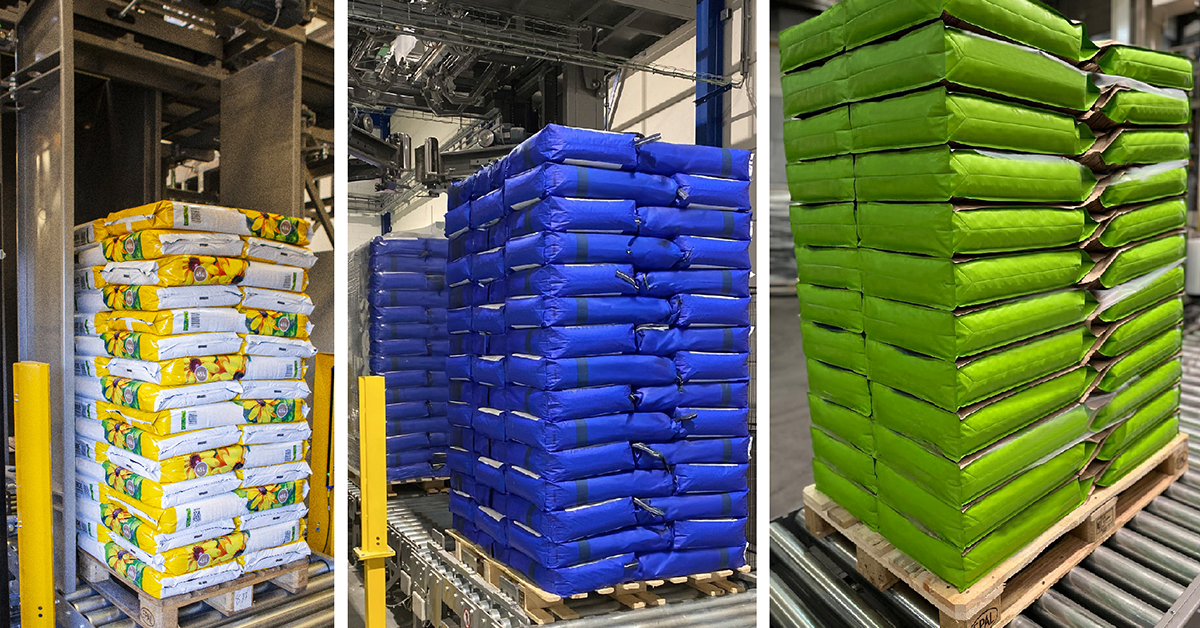
A truck driver opens the rear doors and the load is scattered across the trailer. Torn bags, fallen boxes and frustrated customers are the immediate consequence. Unstable loads cost businesses time, money and goodwill on a structural basis. The good news: pallet instability is rarely bad luck. It is the result of a chain of decisions in stacking, packaging and environment. In this blog we explain where instability comes from and how to prevent it structurally with an automated palletizer and the right stretch hood machine.
What makes a pallet stable?
A stable pallet meets four basic principles. Weight is evenly distributed across the surface, the centre of gravity sits as low as possible, products stay within the pallet footprint without overhang, and successive layers have enough interlocking, comparable to brickwork bonding. Only when all four are met do film or stretch hood become the finishing touch rather than the rescue.
In practice one of these four often fails, sometimes invisibly. A slightly uneven weight distribution, a tilted bag in layer three or a pattern without interlocking goes unnoticed on the production floor, but creates exactly the lateral movement during transport that pulls the pallet out of pattern.
Human errors during manual stacking
Manual stacking is physically demanding work. An operator often lifts thousands of kilos per shift. Fatigue and habituation inevitably lead to sloppiness, even with experienced staff. Concentration drops in the second half of a shift, resulting in slightly less precise stacking patterns, tilted bags and occasional overhang. These small deviations reinforce each other layer after layer.
Practical issues also play a role. Operators switch between different products and bag sizes, with declining mental focus on the pattern. And during peak moments the focus is on speed rather than pattern, with direct consequences for pallet quality and downstream damage in distribution.
Wrong packaging and wrapping methods
Beyond stacking, the packaging itself plays a role. Thin stretch film without sufficient pre-stretch provides too little grip on the load. Insufficient pre-stretch is a common mistake: the more film is stretched before wrapping, typically between 200 and 300 percent, the stronger the final tension effect around the pallet. Too little pre-stretch uses more film and delivers less stability at the same time, a double waste.
Anti-slip sheets between smooth bags (PE film) make a significant difference for products that would otherwise slide between layers. The absence of these sheets is often seen with specialty bags where procurement was optimised on cost rather than stability. Cutting corners here costs more in transport damage and complaints.
The choice between wrapping, stretch hooding and shrink wrapping also has direct consequences for stability. A stretch hood machine pulls a preformed film hood vertically over the pallet, sealing on five sides with significantly higher stability than classic wrapping. For long-distance distribution or outdoor storage this is often the right choice.
Product and environmental factors
Some stability issues lie with the product itself. Bags with too much trapped air bulge upwards and create an unstable base for the next layer. A bag filling machine with bag top de-aeration removes air from the bag before sealing and delivers flat, stable bags for palletizing. The difference between de-aerated and non-de-aerated is visible on the pallet.
Humid storage conditions weaken cardboard and paper bags within days, with decreasing strength layer by layer. A production facility palletizing under humid conditions, such as summers in non-climate-controlled factory halls, sees damage figures spike. Climate control or proper sealing at the palletizing step prevents this.
Vibrations during transport are the biggest enemy. A truck shaking on uneven road surfaces applies lateral forces to the pallet. A good pattern with interlocking absorbs these vibrations, a suboptimal pattern lets them build up to tipping point.
A palletizer as systemic solution
An automated palletizer eliminates the vast majority of causes at the source. The stacking pattern is set in software and executed identically for every pallet, without shift-dependent quality variations. The Votech VPB palletizer places bags using a special rotating head for precise positioning, the VPC uses a turn-and-sliding mechanism to place complete layers at once, and the robot palletizer provides flexibility for varying formats.
An especially powerful tool is the stacking box. This mechanical frame keeps bags or boxes within the exact pallet footprint during stacking. It eliminates overhang completely, protects bags from mechanical damage at the edges and optimises space usage in containers and warehouses. A simple component with significant impact on transport quality.
Securing performance after implementation
A palletizer prevents instability only when properly maintained and when the pattern is reviewed periodically. With every product change, bag swap or film swap the pattern deserves a review. You do this together with your palletizing supplier within Lifecycle Services, typically taking half a day including a test pallet and simulation.
Validation is best performed via a transport shake test or a drive of around fifty kilometres to a test location. For distribution via retail centres, you can perform ISTA-compliant tests. Recommended industry standards are ISO 4180 for packaging tests and the in-house standards of your largest customers.
Conclusion: instability is a system, not bad luck
Unstable pallets are rarely the result of one cause. They are a build-up of suboptimal choices in stacking, packaging and environment. Those who tackle this chain systemically, first by automating stacking, then by aligning packaging with the pallet pattern, and finally by including environment and transport in validation, solve the problem at the source. At Votech we design from this total approach, from filling through to stretch hooding. Our engineers in Reusel are happy to work through your specific product mix.
Frequently asked questions
Why is a good stacking pattern so important for pallet stability?
An overlapping (interlocking) pattern distributes pressure evenly and prevents bags or boxes from sliding during transport. An automated palletizing system calculates and places this pattern flawlessly, even with varying formats and shifts.
How do I remove excess air from bags for more stable stacking?
Use a filling machine with bag top de-aeration, optionally combined with perforated bags for products that need to breathe during storage. The bags are delivered flat to the palletizer, which significantly strengthens the stacking pattern.
What is the difference between stretch hood and stretch film wrapping?
Stretch hood pulls a preformed film hood vertically over the pallet and seals on five sides, including the top. Stretch film only covers the sides. Stretch hood provides significantly higher stability, better protection against moisture and dust, and typically shorter cycle times.
Does anti-slip film really help with smooth PE bags?
Yes, an anti-slip coating or anti-slip sheet between layers significantly increases the coefficient of friction. With smooth PE bags this prevents layers from sliding over each other during transport vibrations. For specific products a special corona treatment on the bag film can also help.
How often should I review my pallet pattern?
With every product change, weight change, bag swap or film swap. As routine, at least annually. A review typically takes half a day including simulation and test pallet, performed within Votech Lifecycle Services.
Which palletizer is suitable for varying bag sizes?
For varying bag sizes a robot palletizer with multi-purpose gripper is often the best choice, or a VPC with turn-and-sliding mechanism. The graphic controls allow pattern changes without hardware swaps.